Monday, 6 July 2015

Ludlow to Worcester

post signature

It rained! No sooner had I left Ludlow, than it started. And so it continued all morning, accompanied by a strong wind, leaving me shivering. It's surprising how even in summer, when exposed to the elements, one can lose body heat. Whilst I climbed steep Worcestershire hills, any possible views were shrouded in sheets of rain and cloud. My back wheel had developed quite a buckle, so much so, that I was forced to stop. Two broken spokes! Fortunately I had had the foresight for such an eventuality, and had removed three spokes from the back wheel I had discarded in Carlisle. It must have looked an odd sight, a penny farthing on its back by the roadside, in pouring rain. By the time I reached Lower Broadheath, the birthplace of Sir Edward Elgar, just outside Worcester, I was cold, tired, and despondent. At least the rain had stopped, and the irregular shape of the Malvern hills were visible.

As I had two hours to spare before I was due to meet Dave Preece, I sat and watched barges negotiating the lock gates between the river Severn and the canal. Never having observed this before, I was surprised how quickly the water rises and falls as lock gates are opened and closed, bringing the barge to the right level. The sun came out, my eyes closed, and before I knew it, I had drifted off to sleep. I was woken half an hour or so later by heavy drops of rain on my face.

Dave cycled his 54" penny farthing from Land's End to John O'Groats last April. It's one of the elegant looking Czech replicas, with lovely attention to detail. Unlike me, he experienced icy winds and snow in Scotland. He also came across people undertaking some bizarre ways of travelling end to end, including two men on BMX bicycles, and a man dressed as superman, who is attempting to set a record for the longest distance travelled by bike, dressed as the superhero. Now why didn't I think of that? Today I am heading for Cirencester, where I shall spend a couple of nights, allowing me a rest day. On Thursday, I shall press on for Bristol and the home stretch.


Sunday, 5 July 2015

Wem to Ludlow

post signature

Many thanks to Adele for her hospitality, and for such a delicious breakfast; sausage, bacon, mushroom, egg, toast and tea. Lovely! And a huge thanks to James, John, Neil and Ian, for accompanying me as far Condover, five miles south of Shrewsbury this morning. I'm sorry I set such a pace and wore them out! The coffee and chocolate brownies were well deserved. Good luck to John who is cycling the length of the Camino de Santiago in August.                


The views across the Shropshire countryside, the fields largely given over to wheat, barley, potatoes, broad beans and maze, were delightful. In the strong breeze, the wheat was producing wonderful shifting, swirling patterns. It was another sunny day, and we had clear views of the Welsh mountains and the Shropshire hills of Wenlock Edge and Corve Dale. We passed through Upper Battlefield, and I was instantly reminded of lines I learnt at college over thirty years ago, from 'Rumour' at the start of Shakespeare's Henry IV part II:

I run before King Harry's victory
Who in a bloody field by Shrewsbury
Hath beaten down young Hotspur and his troops
Quenching the flame of bold rebellion
Even with the rebels blood.

On 21st July, in 1403, there was on this site, a famous battle between the Percy family of Northumbria and the Lancastrian King Henry IV. This was to influence English and French history, and lay the  foundations of the War of Roses which dominated the later 15th century. As I recall from my college days, Henry IV was a usurper. Handing the crown to his son Henry on his deathbed, he warns him against other potential rebels. 'They have but their teeth and stings newly ta'en out,' he tells him. His son, of course, was to become the famous Henry V.

No sooner had James, John, Neil, Ian and myself parted company, than the skies opened and I was once again to get a drenching. For a while I sheltered under trees, but when I realised the rain had set in, I cycled on, eventually sheltering in the church porch of All Stretton for the next hour. As quick as the rain had started, so it stopped. The dark black clouds passed, the sun shone brightly, and steam rose from the roads. There was a pleasing sight of a flock of white racing pigeons, circling against the blue sky. Later in the day I was to see and hear buzzards, and another red kite, it's outstretched wings catching a thermal, making flying look effortless. Passing through Church Stretton, I found myself in the middle of a mountain bike race, riders covered in mud, their clothes soaked, racing past. I let them go. I wasn't in the mood for racing. The A49 from Little Stretton, the last of the three 'Stretton' villages, was treacherous; so much so, that I walked several miles, and then made something of a diversion, including cycling through the small village of Onibury, the minor road running through it, running parallel to the A49 for several miles. Here I found a most delightful and informal pub, 'The Apple Tree,' the former village stores and post office. I ordered a half pint of a really delicious stout, 'Black Knight,' produced by a local brewery. The penny once again caused quite a stir. I'm grateful to the landlord, who I imagined could be cast as Magwitch in Great Expectations, for his generous donation to 'Cycling without Age.'

I eventually arrived in Ludlow, where I was to meet my guests for the night, Nick and Bev, both GP's in Ludlow. They live in Whitton, five miles outside Ludlow, but were visiting Nick's mother Peggy, in her eighties, who had greeted me enthusiastically at her doorstep, supported by her zimmer frame. With eager, excited eyes, she proceeded to tell me about a relative of hers, Conrad Snook, who had won medals and a cup for riding a penny farthing.  Having consumed the pot of tea and a plate of strawberries, chocolate, macaroons, a scone and biscuits that had been awaiting me, I set off for Whitton in Nick and Bev's car, leaving the bike in Peggy's hallway. I jokingly told Peggy I didn't want her riding the bike in my absence.

Later that evening, I was to see photos of Conrad Snook, the cup and medals he won, and copies of an article from 'Cycling Times,' of 1882. He won the cup for riding 214.5 miles in 24 hours on the increasingly popular 'Facile' penny farthing, at that time setting a new record. His medals were for two mile and ten mile time trials.


Nick and Bev live in a delightful rambling house, parts of which dates back to Jacobean times. There are views from the tiered garden stretching as far as the Black Mountains. On my arrival, house martins were flying in and out of nests built under the eaves. Later that evening I saw bats, and then saw and heard owls.

Tomorrow I set off for Worcester, where I will stay with Dave Preece, who like me, a couple of month's ago, cycled from John O'Groats to Land's End on a penny. It will be interesting to share stories.

Saturday, 4 July 2015

Eccleston to Wem

post signature

In the early hours of this morning, there were probably the most violent thunderstorms I have ever experienced. It felt apocalyptical, with bright flashes of lightning followed by explosion after explosion of thunder, rumbling on and on and on. And then there was torrential rain and hail, hammering down on the bivvy tent. By 6.00am, it seemed to be easing off, and now, fully awake, I got up. I had been staying in 'The Charity Farm,' a working farm, that offers camping, caravanning, fishing and horse riding. The owner had a voice that sounded just like Wallace from 'Wallace and Gromit.' Again, the previous evening, I had been struck by the warmth and generosity of people as we entered into conversation; the struggles people have faced, and the donations, drinks and food offered.

As I left the site, there was the cooing of pigeons, and the sound of a woodpecker repeatedly drilling into a tree close by. But after that, nature was to be the last thing on my mind. I was cycling through a largely urban area, with A roads and motorways crisscrossing the map. I was able to make use of quieter B roads for the first ten miles, but cycling through Warrington was unavoidable, along the cycle track beside the dual carriageway of the A49, lined with major stores, industrial units, and fast food outlets like McDonald's and Kentucky. Several motorists or cyclists stopped to take a photo, and share their own cycling adventures. And there was the usual honking of horns, and thumbs up. Then in the centre of the city, I had to negotiate traffic lights, roundabouts, and queues of cars, buses and lorries. I decided to stick to the A49 out of Warrington, as there seemed to be no alternative. And for the next four hours or so, I pedalled along, pretty oblivious to anything, a strong headwind, and the heat of the sun, curtailing my progress. Numerous motorbikes thundered past, seemingly using the road as a racetrack.

It wasn't until I reached the market town of Whitchurch in Shropshire, that I was really able to enjoy cycling again. There were views across stretches of countryside to the Welsh mountains, and the B road to Wem took me through quaint villages, a cricket match being played on one of the village greens. I'd been met in Whitchurch by James, on his carbon fibre racing bike. Not wanting to be too slow for him, I somehow found some last reserves of energy, and we steadied along at ten miles an hour. I was greatly relieved to reach his house. It was so refreshing to be able to take a shower, and enjoy a delicious meal cooked by his wife Adele, a former student of mine.

In the evening, we went to a party organised by one of James's and Adele's friends. Here, I was introduced to a world I'd previously had no knowledge of, that of the 'iron' man. There were a good half dozen or more iron men, ten or twenty years younger than me, talking of very little else but, well, being 'iron.' No, they weren't sharing stories of the most effective way to crease trousers, fold shirts, or of the latest steam generating irons. Nor did they discuss the pros and cons of various ironing boards. This is the competitive world of triathlons; competitive running, cycling and swimming. I was somewhat surprised to discover they shave their legs for that little bit of extra speed, and have iron man tattoos imprinted on their bodies. One iron man had just had a large 'M' dot tattoo imprinted on the rear of his calf, something the other iron men were hugely admiring of. The tattoo is only for men who have completed a challenging human endurance event. It's a large red 'M,' with a large red dot above. All of this gave me an idea. If I shave my legs, might I get that extra half a mille an hour on the penny? Could I start a movement for 'wheel men?' And should I have my own tattoo, being a 'wheel' man as I am?


Friday, 3 July 2015

Kirkby Lonsdale to Eccleston

post signature

There was a heavy dew when I left the campsite, and in the early morning sunlight, burning through the mist hanging over the tops of the dales, everything had a clean and fresh feel. A red hot air balloon hovered in the still air, the occasional sound of it's burners being heard for miles. But the balloon wasn't going anywhere, for even the wind turbines on a distant hill were motionless; and smoke I saw later that morning from a chimney, rose vertically. I was able to keep to minor roads all the way to Lancaster, hardly seeing any cars, following the beautiful Lune valley. The 'Lan' in Lancaster originates from the river Lune. The only problem with such minor roads is that they tend to be hilly, but that is more than compensated for by the views and traffic free roads. I stopped briefly by a gate to have a drink, and a herd of cows came rushing over, steam rising as they snorted. I saw a single brown hare in a field, its large ears twitching and alert. When it saw me it bounded away across the grass, using its powerful rear legs, and disappeared. When I took another brief break, a farmer saw the penny from some distance, and came over with his daughter on a quad bike, to where I was sitting, on a dry stone wall. Like most people on this ride, he asked questions like, 'is it easy to ride?' 'How is it balancing up there?' 'How do you get up?' 'And how do you get down?' 'How far you going?' And 'how far have you come?'            


As I cycled through the lanes, I was greeted with wafts of honeysuckle scent, and strong smells of wild garlic and camomile. I passed through delightful villages, the roofs of the old cottages covered with inch thick slates. Once again, the hedgerows were adorned with dog rose, foxgloves, bright red or purple poppies, wild flowers and grasses. The ride had everything I love best about the English countryside. I am grateful to Penny and her friends for stopping and chatting, and supplying me with some delicious and nourishing flapjack.


By chance, the route I had chosen was the national 69 cycle route, though when I arrived in the village of Halton, I found it impossible to follow the map. By chance, Nigel, a barrister and director of a steam train company appeared, and took a photo of the penny. He subsequently showed me the cycle route that follows the river all the way to Lancaster, winding its way through woods, fields, and beautiful countryside. I am grateful to Nigel for guiding me through the maze of roads in Lancaster, and getting me on my way.

The second half of the day had everything I hate most about cycling; finding my way through the multitude of streets, roads, dual carriageways, traffic lights, one-way systems, and roundabouts in Preston. It was unbearably hot, a heat haze rising from the road, my front wheel picking up wet tar and loose stones. As is usual in large urban areas, I had jeers and cries from young men in vans, or sitting drinking outside pubs. The heat wore me down, and left me tired. 'Sapped' would be an apt word. At one point, as I went to mount the bike, my foot slipped, and I fell heavily on my groin against the frame. How I screamed! It took a good two hours to get from one side of Preston to the other, and to be finally clear of busy A roads. Early evening, I found myself cycling through Eccleston, with its golden letterbox, but there was no sign of Bradley. I'd half expected a penny farthing race through Eccleston high street, but I guess he wasn't up for the challenge.

Carlisle to Kirkby Longsdale

post signature
I managed to largely keep to minor roads today, enjoying all aspects of the Cumbrian countryside, as I travelled down the eastern fringes of the Lake District. There were far reaching views across to the fells, the peak district, and the Yorkshire Dales. At times, I was forced to climb high, and was able get a good view of Haweswater, one of the lesser known lakes, where there have reportedly been sightings of golden eagles. The fields, bordered by limestone dry stone walls, many coated with a thick layer of moss, contained grazing sheep and cows, the lambs and calves feeding greedily off their mothers. In fields adorned with buttercups, there were horses with newly born foals, barely able to stand. Pied wagtails were sitting on telegraph wires, whilst swifts darted in all directions. In many of the fields, farmers were busy cutting grass, or bailing it up. And the fields in which grass had been cut and removed, were dotted with dozens of crows, presumably feasting on exposed insects or earthworms, their blackness such a contrast to the light yellow colour of the cut grass. I passed through picturesque villages, such as Askham and Bampton, the houses built of local stone; and I crossed hump backed bridges, beneath which were bubbling brooks, or larger streams or rivers, in which brown trout could be seen rising. Beneath one bridge I observed a mother duck proudly guiding and protecting her five little fluffy ducklings. And as I cycled through wooded areas, I saw red squirrels scrambling up old oak trees, or leaping between branches.

Arriving in Penrith, I was greeted by an old gentleman, who proceeded to give me a long account of the history of his health, with dates of appointments, names of doctors, and names of various conditions. "Or was it that date? I tell a lie, it was..." I was torn. I wanted to listen, but I was also keen to continue. I was relieved when he was joined by another old  gentleman, wearing a beret, from which protruded wisps of silvery grey hair. This man had a cheeky look about him, and when I changed the subject away from health, and suggested I was now halfway to Land's End, he shook his head, and grinned, revealing his single tooth. He appeared to be the kind of person who was always going to disqualify what had just been said. "Oh no," he laughed, his eyes bulging. He then, somewhat triumphantly, I thought, proceeded to give me the exact mileage from John O'Groats, and the exact mileage to Land's End. The long short of it was, according to him, was that I had at least another hundred miles to go to the halfwway mark.

Today wasn't hot, as I'd been expecting from the forecast. Much of time the sky was overcast, or there was hazy sunshine. By mid afternoon, there were spots of rain, and an hour later this turned into a torrential downpour with a cool blustery wind. The downpour lasted well into the evening. When the rain eventually stopped, I was cycling along country lanes, with views across the Yorkshire Dales, and in particular the hills of Langdale, such as 'The Calf,' 'Calf Top,' and 'Wild Boar Fell.'  There is a strange freshness or newness about the countryside after such heavy rain. Mist clung to the highest peaks, and there was the sound of bleating sheep, a distant cockerel, the cry of a pheasant, the chirping of birds. Cycling was difficult, and for much of the time I walked.The road was like a roller coaster; no sooner had I gone downhill, then the road went up again. I'm also convinced I have been losing spokes when going down steep inclines. I guess that is when the wheel is under the greatest pressure. So, from now on I shall walk down the steeper hills.

It was during the heavy rain, that I met an old farmer. He saw me go past his pick up truck, and looked astonished to see me. He proceeded to follow my bike, both indicators on his truck flashing, for about a mile, only stopping, when I stopped to greet a fellow cyclist, soaked to the skin, beneath a bridge of the M6, close to a huge disused railway viaduct. The three of us got into conversation, the farmer having a broad, and difficult to understand, accent. The cyclist was doing end to end too, but the opposite way round to me. We decided between us that the point on which we were standing was undoubtedly the half way point. I shook the farmer's hand, and his skin had the texture of old leather.

Right now, I am camped in a midge infested field. Immediately outside my tent is an enormous, fat llama, making terrible noises; belching, grunting, spitting and farting. Shooing it away only seems to make it want to stay. The birds are chirping, the sun is rising, and it's time to carry on. I am not looking forward to this part of the journey, through heavily populated and industrial areas, where it will be difficult to find minor roads. I shall work out a route as best I can.

Wednesday, 1 July 2015

Carlisle and 'A Penny for your Thoughts.'

post signature

I woke this morning full of self-doubt, achey and tired. Why am I doing this ride? What's the point? I could so easily quit. It makes no difference to anyone. People think I'm crazy! If I quit, it'll soon be forgotten by others, and I can quickly put the memory of it behind me. Yes, we have choices on our journey's through life, so what gives people the willingness to stay in there when things get tough; like John, the eccentric man from Dalmellington, who nursed his wife for ten years as she slowly deteriorated in health? But then this ride is nothing compared to that, or the hundreds of people I have listened to over the years, struggling with unforeseen changes in their lives; sudden and unexpected deaths of children, illnesses, separations, and losses. I am minded once again to be in the present moment, not think ahead, and not pay attention to what others think. Now is all there is. Is it just coincidence that the word for a 'gift' is a 'present?' So is not the present moment a gift? It's all about where we choose to focus attention. And as has come out repeatedly on this trip, through talking to people, it's the journey that matters, not the destination. Everything can change in an instant, and permanency is illusory. I recollect once again what Adrian Burgess, the climber said, about focussing on the next hand hold and foothold, and not giving the summit any thought. With that in mind, from the local post sorting office, I collected the four remaining spokes I still possessed, that Kathy had sent me, and made my way to 'Re-Bike,' a bicycle recycling scheme in the city.                            
 
"No chance mate," said the manager of the scheme brusquely, when I showed him the small penny farthing wheel. It was a sweltering day, and he brushed away a fly, "It's a solid tyre as well. We just don't have anything like that!" Behind him, in an arched railway workshop, half a dozen oily handed volunteers were busy fiddling with bicycles; fitting a crank, adjusting brakes, fitting chains, and removing wheels. Half of the workshop was piled to the ceiling with bikes for recycling, a tangled mess of bike frames, wheels, brake pulleys, cranks and pedals. I'd known it was a long shot finding a wheel or a tyre; and now, disappointed, guessed I'd have to return to my son's and try and somehow sow the rear tyre together. But just as I was turning to leave, my eye caught one single wheel, still attached to its faded lime green frame. "What about that one?" I asked. It was the sort of weather that induces lethargy. The manager reluctantly disentangled the bike, and removed the wheel. Much to my amazement, it was exactly the same sized wheel as the existing one; identical apart from a different sized axle, which I was able to fit from the old wheel, myself. As can be seen from the photos below, the old tyre was pretty much past it, alarmingly splitting around the circumference of the wheel. I'm lucky I made it as far as Carlisle.


A replacement farthing!  What amazing fortune!


I am grateful to my daughter Chanti, who sent me the following saying this morning. 'People give up so fast, because they tend to look at how far they still have to go, instead of how far they have come.'
Looking at the map of the United Kingdom, I can see that I have in fact come a very long way. I'd say that by tomorrow evening I'll be over the half way point.

It had been my plan today to interview people at the Penny Farthing Cafe this afternoon. Not only did I have great difficulty finding it, every time I passed a pub on route, out would pour half a dozen men, laughing, joking, admiring, or genuinely interested. "Go on, show us how you ride it!" was shouted repeatedly. And I did ride it, to a huge round of applause and cheers. Arriving at the cafe, I found the shutters down, and the cafe empty. It was just about to close. However, Lynn, the owner, stayed open, and made me a baked potato with a tasty chicken and mango filling, together with some salad. As I ate, I noticed on the wall a poster. 'Never quit!' it said. After my lunch, Lynn and I took a few photos of the bike leaning against the railings of the cafe. In the evening I was able to interview two students, and once again was struck by how much our lives are shaped by societal expectations that limit or hinder us.


I will say more about 'A Penny for your Thoughts' as an idea in a later blog. Right now I need to get ready for the next part of the journey. By evening I hope to be in Kirkby Lonsdale. I was grateful for the rest yesterday, and not to have been cycling on the hottest day of the year, and in some places in the UK, the hottest day on record. Overnight there were violent thunderstorms and heavy rain. Right now, the sky is leaden, and I'll be surprised if I don't get a soaking at some point. That could be wonderfully refreshing.

Castle Douglas to Carlisle

post signature

The morning started with a most difficult decision, to stay in bed or get up. And what made that decision difficult, was the fact that I was snuggled up in my sleeping bag, whilst rain was pounding on the bivvy tent, sounding just like exploding popcorn. I was camped under an old oak tree, and with every gust of wind there was an additional downpour from the leaves and branches above, as if someone were throwing buckets of water over the tent. What also made the decision difficult, was the small size of the tent, a Rab Ridge Raider (which impressively kept me perfectly dry). Getting in is a question of going in feet first, and then pulling all the luggage in afterwards. Getting out is the same, but in reverse. This means, exiting the tent on a rainy day like this morning, exposes all the luggage, clothes, and maps to the elements. Eventually, I made a dash for it, wrapping things as best I could and preparing to get on my way. It was six thirty! And from the reflection of in the mirror of the shower room, and the bags under my eyes, I could see that I was dehydrated.  

There is a gym next to the campsite, and as I was leaving, the door opened, and out popped a large, bald, tattooed man, in red shorts and a red sleeveless vest. He instantly reminded me of Big Daddy, the wrestler. If you're too young to remember Big Daddy, let me tell you, he was a huge man, with a mighty chest, arms, and legs. He would pick up his opponents, fling them over his shoulder, and then land on them with a belly flop. He was the wrestler everyone loved to hate. "Hey," said the man enthusiastically, in a broad Scottish accent, "my grandfather was the first man to ride a penny farthing through the Gatehouse of Fleet!" An image of a stalwart figure, dressed in black Victorian clothing, riding proudly through the town, to the admiration of onlookers, entered my mind. Big Daddy then went on to tell me how his family had been blacksmiths, and could be traced back five hundred years in their association with this trade. The Gatehouse of Fleet, is a small town in the civic parish of Girthon, Kirkcudbrightshire. Most of the industry of the town centred around cotton mills.

By lunchtime, the heavy cloud had lifted, the sun was hot, and the air was excessively humid. My shirt clung to me, and there was nothing I would have liked more than to be able to jump into a cool river. Every few miles I was forced to refill my water bottle. There were some beautiful views across the Solway Firth to the Cumbrian Fells, dark blue shaped mountains on the horizon. In the fields I saw newly born calves, still struggling to stand, and there was the smell of freshly cut grass. The hedgerows were largely adorned with pink dog rose, large white daisy flowers with yellow centres, and purple loosestrife. Swifts darted in and out of the eaves of the largely single storey houses in local villages.

All the teachers, and all the pupils of the local primary school were waiting to see me as I cycled up an incline into the village of Mouswald. I stopped and had a chat as they took photographs. I then said goodbye to the two pupils and the teacher, and cycled on. Yes, this has to be the smallest state run school I have ever encountered. Not much further down the road, I was to meet a most unlikely character, dressed for tennis. He seemed an unassuming, quiet sort of chap. Now maybe it was on account of the excessive heat, and a touch of sun stroke, but after a while conversing with him, and getting no reply, I told him I thought he was not playing ball, and was bone idle.


I was pleased half a mile further down the road to be flagged down by Edith. She and her husband Colin, had literally just returned from a five week holiday, but as has been characteristic of this trip, they kindly invited me in. Edith cooked up two bacon butties and made me a hot mug of coffee. Delicious! In Annan I was greeted by the local reporter, who proceeded to take numerous shots of me cycling down the main high street. "We heard you were coming," he said. A few miles outside Annan, just past the Devil's porridge museum, I met a farmer, John Beattie. He had been waiting by his gate for some time in the knowledge that a penny farthing was on its way. He was delighted to see me, and took numerous photos of the penny. He then proceeded to show me his collection of two cylinder David Brown tractors, all of which he displays at vintage rallies. "You've made my day," he told me repeatedly.


I have always loved porridge, so I was intrigued by the idea of a museum devoted to the history of my staple breakfast. However, the Devil's porridge museum tells the history of a munitions factory that has been described as the greatest on earth. Known as HM Factory Gretna, and founded during the First World War, it stretched for nine miles along the Solway Firth, and produced more cordite than all the other UK factories combined. In 1917, it produced 1,100 tons of cordite a week, an explosive powder made of nitrocellulose, nitroglycerin, and petrolatum, then dissolved in acetone, dried, and excluded in cords. Eastrigg and nearby Gretna both provided housing for up to thirty thousand workers. Amazing statistics, I thought, as I pedalled away. But is there really no other way to manage conflict than to produce tons upon tons of explosives?

Gretna Green is renowned for its runaway weddings. It is one of the world's most popular wedding destinations, hosting over 5000 weddings a year. I was greeted in Gretna by Chris, an Australian. Having taken a picture of the penny, he informed he was here to get married to the Scottish woman from Edinburgh, he has been living with for the last nine years in Australia. Chris works in a gold mine as a cartographer.

Shortly after leaving Gretna, I crossed the border.


I am on the homestretch now, I thought. However, the last few miles to Carlisle, on a road directly adjoining the motorway, seemed endless. I was hot and parched. As I approached the city, I stopped at some traffic lights. A black car with a loud exhaust, and music blaring, pulled up beside me. It was full of young lads. "Hey mate," shouted the driver, "your wheel's too big!" There was the sound of irritating raucous laughter. Eventually I neared my destination, the smells from the McVitie's factory wafting in the air, making me realise how hungry I felt.  I am looking forward to a day's rest, the hottest day of the year to date I understand.

Tomorrow I must sort out the back wheel, and true the front wheel. I lost a further four spokes yesterday, and I can only assume this is to do with the bumpy road surface, as I am not excessively tightening them. I am disappointed I have been unable to conduct more interviews, 'A Penny for your Thoughts.'  Maybe I am used to adopting a reflexive stance to life, whilst for others it is more threatening. Perhaps I am diving in too quickly, and need to allow the conversation to evolve. I'll visit the Penny Farthing cafe tomorrow and see if I can find people willing to converse.

Monday, 29 June 2015

Prestwick to Castle Douglas

post signature

Today has undoubtedly been the toughest day so far, both physically and psychologically. The weather began grey and  drizzly, and there was a strong head wind all the way to Castle Douglas. This makes a significant difference when sitting so high with all the body exposed. Although the road was reasonably quite, occasionally huge, long log lorries thundered past. I felt tired, despondent, and preoccupied with the back wheel tyre, which is splitting down the middle right around the wheel. I am hoping it will get me as far as Carlisle, where I will take a day's rest. I certainly didn't expect to get me as far as it has done today. Hopefully, in Carlisle I can either purchase a new wheel, or tyre, or sow the tyre together from side to side with a tough needle and very strong thread. Alan, the unicyclist I stayed with, recommends a product called Sikaflex, used in the marine industry.

As I cycled out of Ayr, leaving the Scottish west coast behind me for good, I was joined by a single cyclist. He explained to me how the huge cargo ships docked out at sea transport coal. They wait until they are sent to obtain it from the cheapest seller, sometimes as far away as the United States or China.    

My arrival in Dalmellington, a small Scottish town eleven miles outside of Ayr, caused quite a stir. A group of men stood around the bike reminiscing, and then the workers from the bank, outside of which I had left the bike, left their posts to take photos. One of the old men, with a weathered face, wearing a cap, informed me that back in the 1930's, the police constable for that area, John Millen, went everywhere on a penny farthing. The old man also told me how as a young man he could earn seventeen pence a week down the pit, with bonuses. He'd saved up and bought his first three speed, and he and a group of seven friends had cycled all the way to Blackpool for their holiday.

One of the men kept fingering the solid front tyre of the bike, explaining to one of the other men how solid tyres were good, as you could shoot at them, and even with holes in, they would still roll. I hoped he wasn't about to try this theory out on my penny as I left town! Another man who had gathered to look at the bike, very much like Billy Connolly in his demeanour, insisted on showing me his biceps, then rolled up his trousers to show me his leg muscles. On his phone he then showed me pictures of his great grandmother, grandmother, and mother; and of himself with a long beard and shades, wearing different hats; and a picture of weights lifted clean above his head as a younger man. "They weighed five and a half stone," he said, "and I could lift them up and down all day." Behind the somewhat manic presentation, I think there was a great degree of sadness. He had lost his wife the previous year to multiple sclerosis, and had spent years before that nursing her, and carrying her.

Yesterday was the whisky cyclist. Today, I met the Brompton crochet cyclist. She introduced herself to me in Patna. Everywhere she stays, she crochets something. She is currently touring Scotland on her bike running crochet workshops. "I'll have to crochet a penny farthing now," she cried as I cycled off. Further details can be found on http://createwithfibre.blogspot.co.uk/

Despite my tiredness and despondency, I was struck by the beauty of the southern uplands, with their rolling hills and pine forests. I saw some kites circling above Loch Ken, the redness of their feathers revealed as their bodies caught the sun. As on previous days, I enjoyed the smell of pine resin from freshly cut wood, the sounds of chirping birds, the diving and darting of swifts, and the sight of numerous wild flowers. And today, maybe because the sun came out in the afternoon, and it was warm, I saw butterflies.

I have erected my bivvy tent in a campsite in Castle Douglas. The warden, knowing the ride was for charity waved the fee. Such kindness has been my experience over and over again. I was in a cafe this evening, eating pie and chips and drinking tea. The lady serving me informed there have been reports of two penny farthings in the area. So maybe I do have an impostor!

Sunday, 28 June 2015

Hunter's Quay Dunoon to Prestwick

post signature

Well, it was inevitable it would happen! Arrested for going too slow! But a huge thanks to the two police officers who eventually let me off after several hours in a police cell, without charge, provided I got a move on.                          


The ferry trip across from Hunter's Quay had been rough, with large waves and a strong headwind. And there had been a persistent drizzle. I was grateful to the ferry crew for providing me with free passage. After an hour or so, as the cloud cleared, and the sun came out, everything was transformed into vibrant colour. There were beautiful views across the Firth of Clyde to the Isle of Arran, with its lofty peaks. Yachts with colourful sails moved briskly on the wind.

Once again, I saw oyster catchers, calling loudly, diving and dodging as they chased each other; heard skylarks as they fluttered high into the air, only to dive back into the thick grass; heard the cheeping of yellow-green siskins, as they flitted between trees; saw plovers, running along the shoreline erratically, before stopping briefly to feed; and saw lone herons standing at the edge of streams or pools, tense, poised, and ready to strike out with their dagger like beaks.


Before I was arrested in Largs, I'd cycled along the promenade, past amusement arcades, shooting galleries, 'Jungle Blades,' and a merry-go-round. I was stopped by a man who'd seen me the previous day cycling along Loch Fyne. In fact, he'd stopped to take my photograph, and expected me to remember him for that. He told me his wife had seen me the previous Saturday, cycling along the West Coast. "Not me," I said, "I didn't start riding until last Sunday. Are you sure it was Saturday?" And he was sure. "He even wore a blue top like you!" I came to the conclusion that there must be two penny farthing riders touring Scotland right now, or that maybe I have an impostor. As to why I wouldn't remember this man, there's another thing you need to know should you now be inspired to purchase a penny farthing, and like me travel from John O'Groats to Land's End. People will take photos and film of you with alarming frequency, even with one hand on the steering wheel. They appear suddenly, as if they have had forewarning of my arrival, as if I was some vintage steam train, and scream out 'smile!' I don't think I have had so many shots taken of me as I have had this week.

I met Martin the whisky cyclist today, as I cycled route 7, the twenty-two mile 'Lochs and Glens' cycle track along this stretch of coastline. He visits festivals, distilleries and shops; and tours the UK, and particularly Scotland, sampling whisky. He has created his own website, with lots of fascinating pictures. Take a look at: http://whiskycyclist.weebly.com/  This evening I am camping in a caravan park in Prestwick, my tent next to a large camper van. I am grateful to Gill and Peter for the soup, bread and cups of tea. Peter has an interesting hobby dressing up as General Eisenhower, getting involved in World War Two battle reenactments, and giving speeches as the great general himself.

Tomorrow I head inland, towards Dumfries. By Tuesday, sadly, I will leave Scotland behind me.


Saturday, 27 June 2015

Taynuilt to Hunter's Quay Dunoon

post signature

I am sure it will come as no surprise, to those who know me well, that out of the two choices of ride available to me today, I took the longer, harder, sixty-four mile ride to Dunoon. It was a largely pleasant journey, beginning with a meander through grassy meadows, highland cows chewing cuds of grass, the sound of a cuckoo reverberating across the valley. Then I cycled through the pass of Brander with its steep inclines, down from which crashed huge waterfalls. The pass, after six or seven miles, gave way to the sparkling waters of Loch Awe, the banks of which were largely lined with deciduous trees and purple rhododendrons.  

The climb to the top of Glenn Array was steep and tiring. But the sun was out, and it was great to feel its warmth. And as I neared the top of the Array, walking due to the steepness, a breeze picked up. It's hard to describe just how refreshing this was. It left me thinking about 'Cycling without Age,' which was much of the motivation for undertaking this ride. Years ago, in my twenties, I worked for a short period on a ward for older men. Few had visitors, and from time to time the curtains would be drawn around a bed, and the deceased occupier removed, only to be replaced with another old man the following day. Talking to patients was discouraged; it meant you were being lazy. I remember asking one old man how long he had been there. "Three years," he said. "How often have you been out in that time?" I asked. "Never," he replied. Flouting the rules, I obtained a wheelchair. And an hour later we stood on a hill high above Salisbury, the wind in our hair (those were the days when I still had some), the sun on our faces. He pointed to various locations in the city below, and came alive as he chatted about his life, work, experiences, and family. The smile on his face, and his gratitude were deeply rewarding. There was another occasion, working in London, in an extremely busy old people's team, for Brent council, when a request came through from an old lady, Iris, for help with washing and dressing. This was low priority, and so it was three or four weeks later that I knocked on her door. I recall so vividly how she fell into my arms and sobbed. Weeks previously, she'd gone to the post office to collect her pension. Confronted by a youth, a large piece of timber in his hands, he'd demanded her money. She'd refused, and the youth had struck her repeatedly across the ribs. That's why she needed help washing and dressing. And not wanting to bother anyone, or make a fuss, she had put up with the pain and isolation. I worked for some weeks with Iris, and recall vividly how her face lit up when I turned up one morning with a bunch of flowers, and how she in turn struggled out to the shops to buy my two young children some presents. "You've restored my faith in humanity," she told me. These are moments of connection. And they really matter. We live in a society where loneliness and isolation for older people is so common, where the language we use marginalises and discredits them; old codger, dirty old man, old biddy, senile, demented, cantankerous, and fogey. We'll all be old one day. For me, loving the outdoors as I do, particularly cycling, feeling the warmth of the sun on my face. and the wind in my hair (what's left of it), and having people to talk to, to share my story with, will be all important. I look forward to seeing the rickshaws along the cycle tracks in Exeter, and the connections that will be built between volunteers and our older generation.

From the top of Glen Array, their was a steady descent into Inveraray, and Loch Fyne. This wasn't too steep, and so I was able to freewheel most of the way. I had contemplated stopping here for the night, but it was only midday, and it quickly became evident the small village was a tourist honeypot. There was an endless stream of roaring motorbikes, coaches and camper-vans travelling along the A89. I'd only just stopped for some lunch - bread, cheese and a large ripe tomato - sitting on a bench overlooking the loch, when there came a voice from behind me. "Nice bike. May I take photo?" I turned to see at least a dozen Chinese tourists, with their iPod's on selfie sticks. "Smile for camera please." Click, click, click.

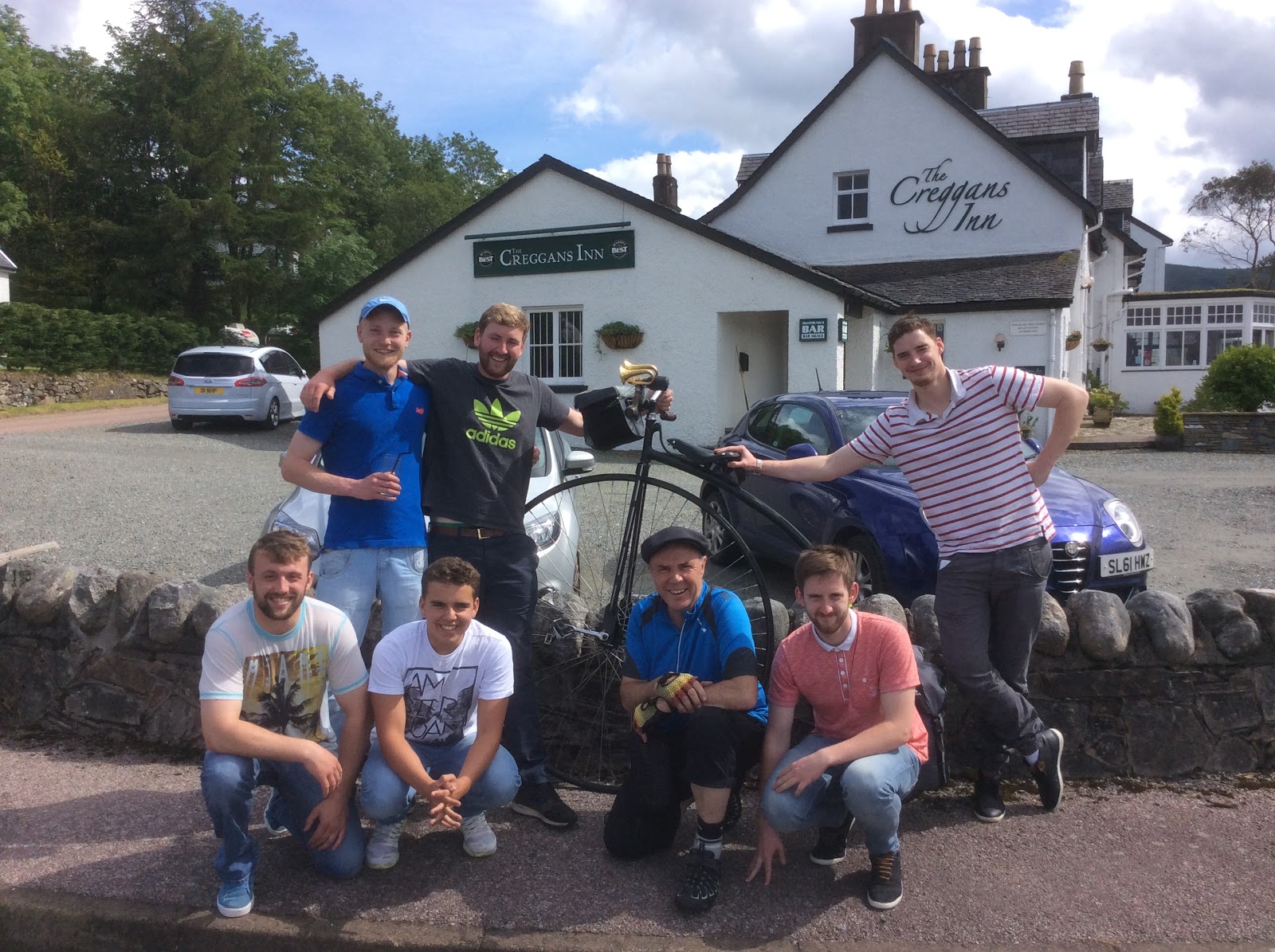
The most frustrating part of the day was what seemed like an endless diversion around the far end of Loch Fyne. After nearly three hours, two of which were on the busy A89, I finally reached a point which was probably no more than half a mile across the water to Inveraray. But I was to be rewarded for my efforts. As I reached Strachur, and the turning for Dunoon, out of the Creggans Inn appeared seven Scottish lads, cheering, waving, and crying out enthusiastically. They had passed me earlier in their cars. One had a glass of orange, in which were ice cubes and a straw. "It's for you," he said. "You deserve it!" The lads subsequently took a number of my cards promoting the ride and the charity.


The last part of the day's journey took me down to Holy Loch, in Hunter's Inn. I walked along the shore front, watching dunlin in flight. I love the way in which they swerve their path, and coordinate their movements together, as if they were in some preplanned dance. Tomorrow I will take the ferry across the Clyde to Gourock. Although I shall cycle down the coast for another forty miles or so, it will be through largely built up areas. Despite the endless rain and the midges, I find myself sad to be leaving the wilder aspects of the west coast behind me.

Before I go, should anyone now feel inspired to follow in my tracks and purchase a penny farthing, I need to make you aware of two things. Firstly, be aware, should you visit the west coast, that midges have a top speed of four miles an hour. Consequently, you need to be sure you can maintain such a pace in order to stop them bothering you. Secondly, apart from the dangers of a 'header' I have described, there is another potential hazard. If you have ever watched a Robin Hood film, and in particular a chase on horseback, you'll know how the pursuing rider - normally one of the sheriff of Nottingham's evil accomplices - will often be knocked out of their saddle by an overhanging branch. This is the hazard for the penny farthing rider. All along the cycle track, following the Caledonian Way, I had to keep ducking; so much so that I am inclined to write to the powers that be for Argyll and Bute and request there is a clear pathway made available to the height of ten feet.